


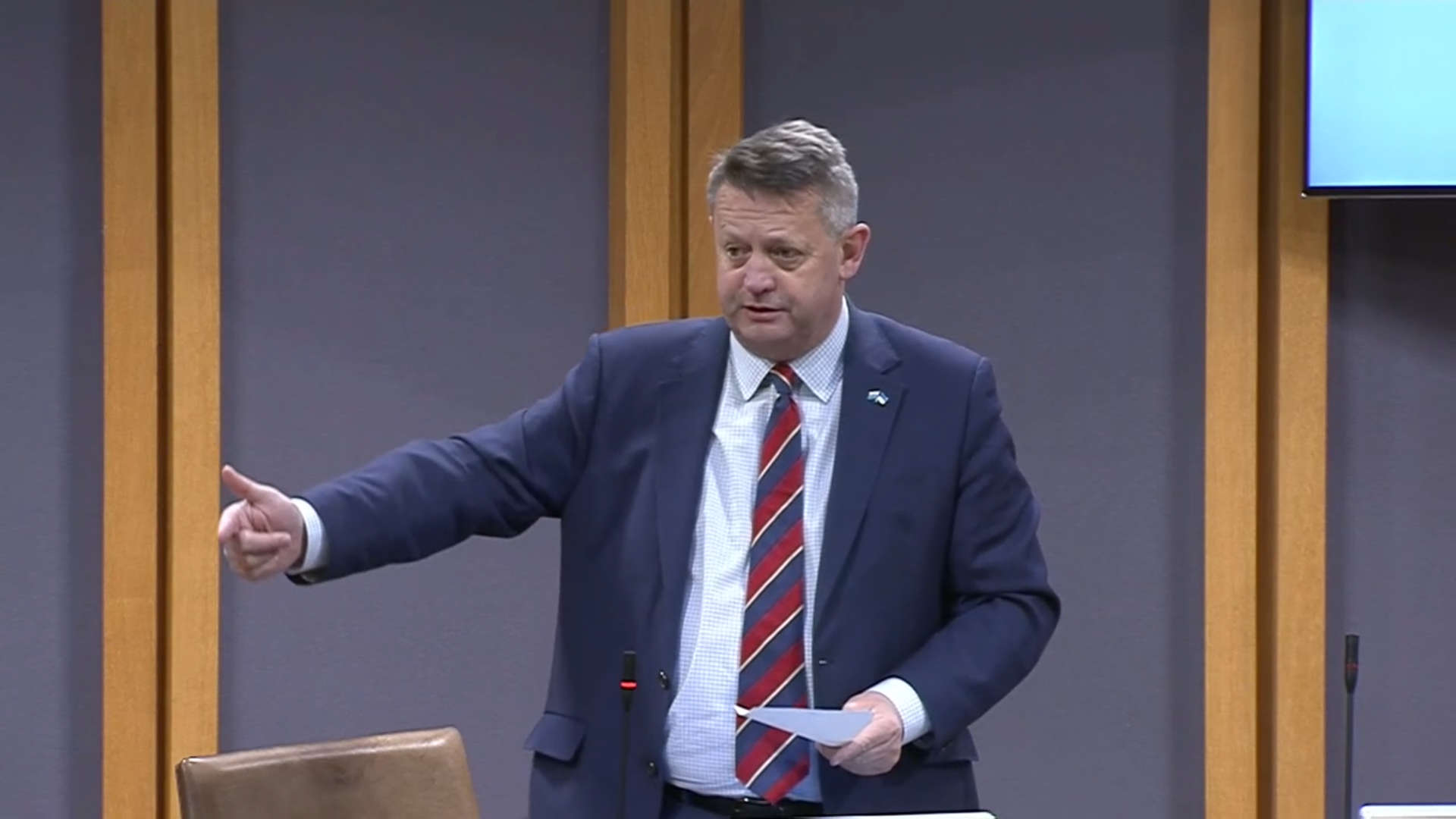
A Labour Senedd member called for voters to be given a say over who replaces politicians removed from office for wrongdoing under a new "recall" system.
Alun Davies argued the people – rather than political parties – should decide who is returned following a public vote to remove a sitting Senedd member between elections.
Under a system proposed by the Senedd's standards committee, and backed by the Welsh Government, the next candidate on a party's list would automatically be returned instead.
In 2026, Senedd elections will move to a fully proportional "closed-list" system – which will see people voting for parties rather than candidates – with first past the post ditched.
But Mr Davies argued it would be perfectly possible to hold by-elections under a closed-list system using the alternative vote to maintain proportionality in the Senedd.
'Accountability'
He told the Senedd: "I believe we do need to maintain the principle of the electorate being able to pass judgement, not simply on the individual but on who follows them."
Mr Davies pointed to the alternative vote system used in the Republic of Ireland for by-elections in the Dáil, the lower house of the Irish parliament.
He said: "The role of the electorate comes...in the place of elections and accountability and, for me, that means that we do need to hold by-elections in any system."
The Blaenau Gwent MS added that he "fervently hopes" the closed-list system to be used in May 2026 will only be in place for a short time.
Mr Davies made the case for the single-transferrable vote – which would give voters a say over the order of candidates on party lists – as a longer-term solution.
'Answer to the people'
In November, the Electoral Reform Society (ERS) Cymru similarly backed calls for voters to have a say over who replaces a Senedd member ousted from office.
ERS Cymru director Jessica Blair said automatically replacing someone with the next person on the list could be seen as the party being rewarded for bad behaviour.
Under Westminster's system, most of the by-elections triggered by recall petitions in the UK Parliament have been won by a different party but in Wales the party would retain the seat.
Welsh Liberal Democrat leader Jane Dodds, a former MP who won a by-election following a recall in Brecon and Radnorshire, warned trust in politics is at an all-time low.
The sole Lib Dem in the Senedd said: "The power of recall is not just its ability to remove an elected representative, it is the message it sends: that politicians must be held to high standards of conduct – or answer to the people."
'Remove or replace'
Leading a debate on Wednesday, committee chair Hannah Blythyn described the report on introducing recall as a significant step to ensure confidence in the political system.
A "remove-or-replace" vote would be held under the plans, asking the public if they want to retain a politician who committed a "serious" breach of the Senedd's code of conduct.
The ballot would be held on a single day, with postal and proxy voting, unlike in Westminster where a recall petition is opened for six weeks before a by-election is triggered.
The committee similarly diverged from the UK system by not setting out any specific triggers that could lead to a "remove or replace" ballot, with much of the detail to follow in guidelines.
Samuel Kurtz, a Tory member of the committee, pointed out that the Senedd is bringing forward a recall system "far sooner" in its history than the House of Commons.
'Most democratic institution'
Plaid Cymru's Peredur Owen Griffiths raised the need to find a compromise, balancing the characteristics of the new electoral system against effective accountability.
Labour's Mick Antoniw, the architect of the new system, said: "It is a brave and radical step. It will create, I believe, the most democratic institution in all of the parliaments of the UK.".
Julie James outlined ministers' formal response to the committee's recommendations, committing to bringing forward a bill on recall before the 2026 election.
Ms James, who is Mr Antoniw's successor as counsel general, the Welsh Government's chief legal adviser, argued clear-cut triggers should be explicitly listed in the bill.
She said: "Public trust in politics is hard-won but easily lost, and it's our duty to safeguard it. People rightly expect high standards from their elected representatives and when those standards aren't met, they expect consequences."
 Pink poppy display commences with celebration of life
 Former Barry office block converted into new homes for people at risk of homelessness
 Welsh Government publishes independent report on Level 4 intervention at Cardiff and Vale UHB
 Three CoastSnap stations set to be installed along the Glamorgan Heritage Coast
 Daffodil Runner statue installed at Marie Curie Hospice in Penarth
 Woman Dies After Incident in Leckwith as Police Investigation Continues
 Vale entrepreneur wins national Innovate UK award for sustainable construction technology
 Cardiff Airport retains top accessibility rating as regulator reports record demand for assistance
 Open Doors event to showcase hidden world of Glamorgan Archives
 New details have emerged of a new tree-lined public square that will replace a traffic dominated junction
 Dyffryn Gardens’ Edwardian rose garden blooms again after decade-long restoration
 Barry’s Own Daniel White to Walk 190 Miles Back to Where His Round Table Story Began
 1,300 people attend Flying Start Family Fun Day
 Dispersal order put in place to tackle anti-social behaviour
 Interim Chief Executive Appointed at Cardiff and Vale University Health Board
 Cardiff Theatre Marks 50 Years of Service for Long‑Standing Staff Member
 Council to review use of GP letters as evidence for disability claims
 Plans have been put in place to redevelop a complex with more than 20 flats
 Vale Council Reaccredited Under White Ribbon Scheme as Part of Ongoing Work to Tackle Violence Against Women and Girls
 Two Vale Restaurants Among Those Set to Close as Whitbread Shuts Brewers Fayre and Beefeater Chains